

Escape rooms have purposes beyond just weekend entertainment. They have evolved into a creative means of challenging young brains and supporting talents transcending the game itself. Children like the experience; parents and teachers value the developmental gains. Let’s investigate how these immersive events help kids become problem solvers.
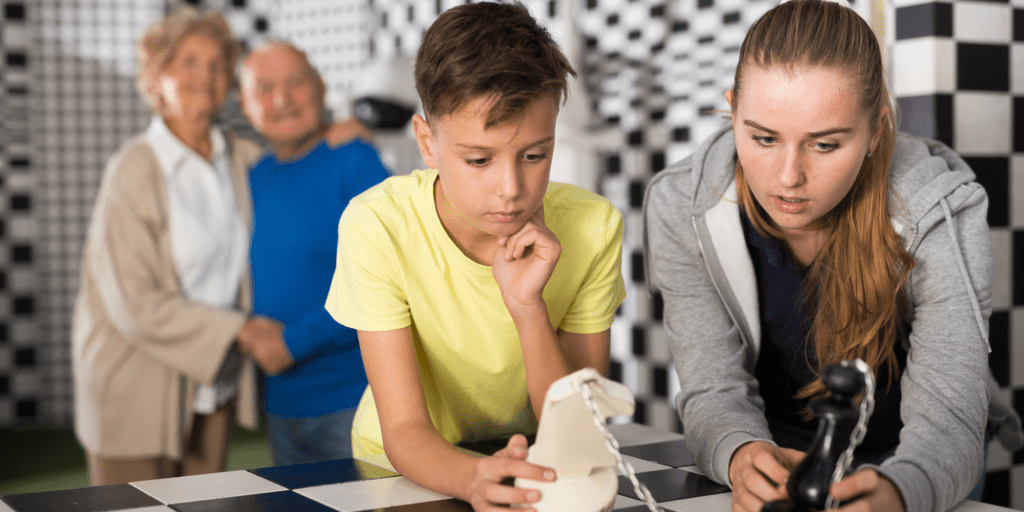
Table of Contents
Developing Critical Thought in a Playground
Children flourish when learning seems to be play. Escape rooms are meant to captivate participants with logical thinking-requiring riddles, puzzles, and hints. Children have to assess the matter, use critical thinking, and decide on the best line of action.
In these situations, they have chores without clear solutions. A locked box could call for identifying concealed objects in a room or working through a mathematical problem. These difficulties inspire kids to explore things from several aspects and go beyond the apparent.
Lack of modern screens accentuates the appeal. Children engage in hands-on, interactive experiences working with real materials and tools. This facilitates their connection of theoretical concepts with practical uses.
Promoting Cooperation and Team Performance
Rarely are escape rooms a lone trip. Teams cannot succeed without cooperation. Children should thus learn to share ideas, pay attention to others, and efficiently divide work.
Consider a bunch of young people in an escape room. One child finds a secret hint; another answers a related puzzle; yet another links the bits to reveal the next action. Cooperation and communication define success. In the classroom, on the field, and in future offices, these abilities are indispensable.
Disagreements do happen—that’s normal. Children learn under the pressure of a ticking clock how to rapidly and forwardly handle problems. It’s a great approach to hone flexibility and compromise.
Improving Our Capacity for Making Decisions
Escape rooms call on fast thinking. Children are given many avenues with possible hints. Part of the difficulty is choosing which lead to follow initially.
Children learn from this process of making decisions to consider alternatives and evaluate outcomes. For a more difficult problem, for example, deciding to start with a smaller puzzle first may release tools required. One of the most important life skills is how to prioritize chores under time limits.
The instantaneous feedback in the game—either advancing or being locked—helps children see the consequences of their decisions. This is a secure place where learning includes errors.
Increasing Self-Confidence by Success
For children, success in an escape room may be rather liberating. Solving problems and finishing difficulties helps them to believe in their own ability.
Little triumphs like cracking a code or discovering a secret key help the team to gain confidence even if they fail in time. Young children understand that even if the ultimate objective isn’t accomplished, effort and tenacity result in advancement.
Many times, this increase in self-esteem permeates other spheres. A child who solves a difficult challenge in an escape room could be more confident approaching a demanding topic in the classroom.
Restoring Attention to Detail and Focus
Escape rooms’ immersive qualities call for focus. Every clue counts; distractions might stop development. Children pick up on fast the need to observe their environment.
For example, the next step might be found in an apparently everyday object. Often the difference between success and failure is spotting small trends or links. This helps kids to see nuances others might miss and sharpens their observational abilities.
These teachings transcend the game. In academic environments, from reading comprehension to scientific research, the capacity for focus and detailed observation is priceless.
Time Management in Instruction
Escape rooms are time-bound; most games run an hour or less. Children have to strike a balance between the desire to act fast and extensive inquiry.
Time management becomes a communal effort. Teams sometimes distribute tasks to guarantee that none is missed. Children that follow this approach learn the worth of time and how to make sensible use of it.
More broadly, these abilities have application in daily life. Time management is a fundamental ability for success whether one is finishing schoolwork, getting ready for tests, or engaging in extracurricular activities.
Encouragement of Originality and Innovation
Many times, escape rooms feature unusual obstacles meant to inspire innovation. Children could have to consider other uses for objects or decipher hints in unusual contexts.
A puzzle could ask for, for instance, non-traditional pattern alignment of colors, shapes, or symbols. These exercises inspire creativity and enable kids to approach problems from unusual angles.
Creativity isn’t limited to artists. A vital ability for addressing problems, it helps children to come up with original answers when more conventional approaches fail.
Building Resilience and Perseverance
Escape rooms aim to be difficult. Children will probably experience times of annoyance when a solution does not come naturally. These encounters help kids to realize the need for resilience.
Children discover to try several strategies rather than giving up. They start to have a growth attitude, seeing that mistakes are chances for development.
A vital life ability is this tenacity. Resilience enables youngsters to adapt and flourish in social contexts as well as in intellectual ones.
Designing Unforgettable Educational Opportunities
Escape rooms’ immersive quality helps one remember them. Children are more likely to remember teachings acquired via practical experience than by conventional instruction.
Teachers and parents might find great use for these events. Talking about game performance and areas for development supports the learning. These dialogues also help to improve relationships between adults and children, therefore ensuring that everyone finds learning fun.
Escape rooms can even be customised to fit instructional themes by including science, maths, or history. This keeps youngsters involved by combining play with education.
Final Thought
Escape rooms serve more than only amusement value. They give kids a special stage on which to grow creatively, resiliently, and with problem-solving ability. These games provide insightful teachings in an entertaining and interesting way that reflect real-life events.
Escape rooms should be part of the activities parents and teachers trying to foster development in young brains think about. From a family getaway to a birthday celebration to a school trip, these events have advantages much beyond the game. Children leave not only with memories but also with abilities that will help them succeed going forward.




never had the experience of these room’s
can see how they would be beneficial
I have not been to one yet but really want to
Never been one to enjoy an escape room,but if it helps children develop then thata good
I would love to go to one and can see how they can be beneficial to kids
I think some of the escape room ‘plots’ are so creative
I keep saying we need to do one as not experienced one yet
I love an escape room with friends and I said to my partner that we need to do one this year with the kids. They are great fun as a family I imagine.
We have not done one yet and know of two locally and keep saying we need to do one